Survey of Current State and Near-Term Outlook for At-Sea Deployment
A Crucible Insight White Paper | May 2026
Abstract
This white paper assesses the quality-control architecture governing additive manufacturing in DoD maritime operations, with specific attention to shipboard and at-sea deployment across the U.S. Navy, U.S. Marine Corps, U.S. Coast Guard, and Military Sealift Command. The analysis draws on DoD additive manufacturing policy, DoDI 5000.93, NAVSEA metal additive manufacturing technical publications, NAVSUP source approval guidance, USMC additive manufacturing policy, DoD Inspector General cybersecurity findings, AWS D20.1, ISO/ASTM additive manufacturing standards, ABS, DNV, and Lloyd’s Register classification guidance, relevant Military Standards for shipboard environmental qualification, NIST digital-thread products, and current open-source reporting on Navy additive manufacturing activity.
The paper applies a composite gap-analysis model across four quality-control dimensions: standards treatment, shipboard environmental qualification, workforce qualification, and digital thread, data integrity, and traceability. Polymer and metal additive manufacturing are evaluated in parallel because they occupy materially different maturity positions. Polymer systems are more widely installed aboard ships and supported by broader international consensus standards, while metal systems have more developed Navy-specific technical authority documentation but remain more limited in demonstrated shipboard operational deployment.
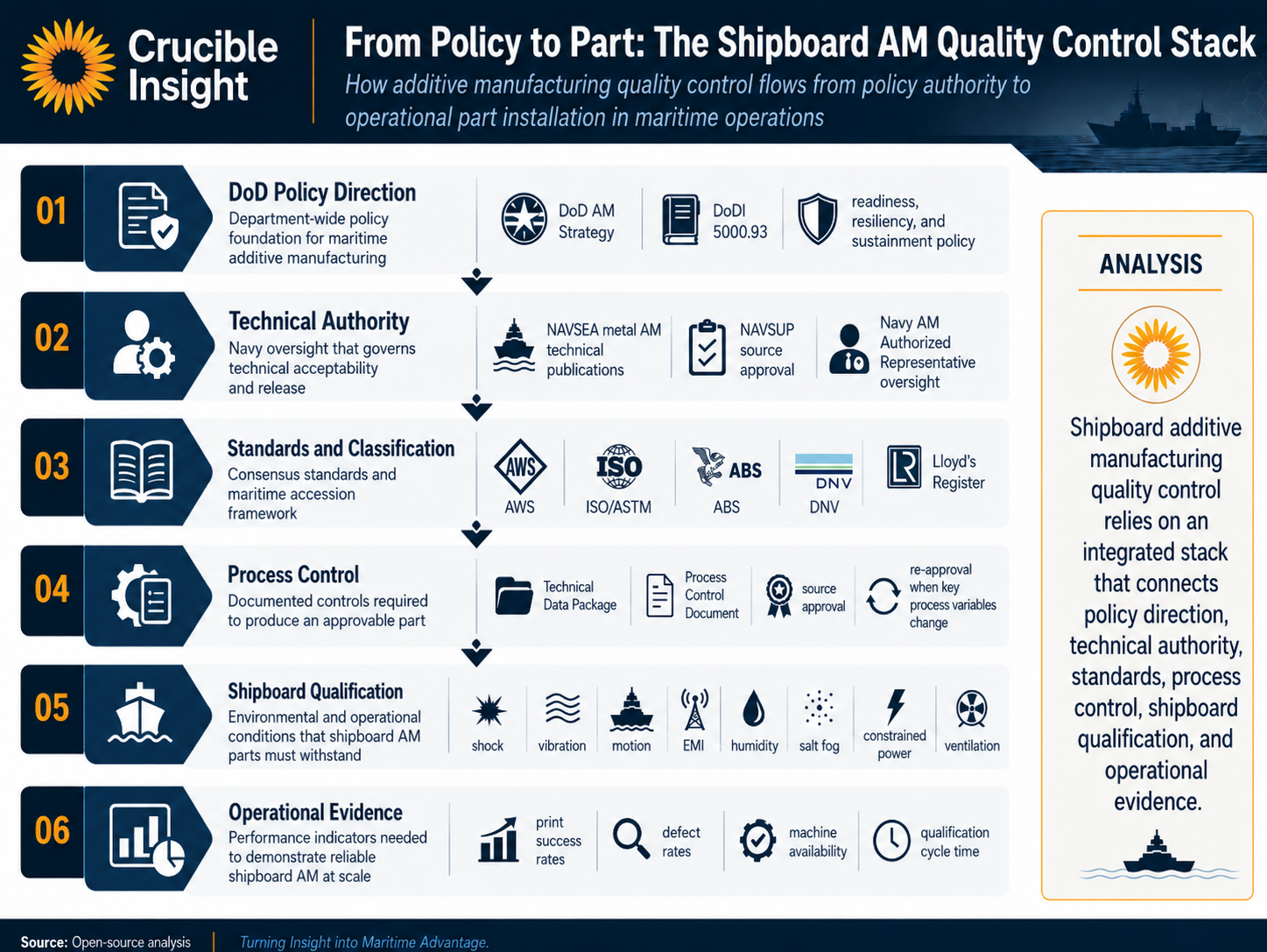
The central finding is that the policy and technical-authority infrastructure for additive manufacturing has matured faster than the disclosed operational evidence needed to prove reliable shipboard production at scale. DoD and Navy governance structures establish a clear framework from department-wide policy through NAVSEA technical authority, NAVSUP source approval, process-control documentation, and authorized representative oversight. Consensus standards and classification society guidance provide additional criticality-based qualification pathways. However, authoritative open-source data on shipboard print success rates, defect rates, machine availability, qualification cycle times, and long-duration part performance remain limited.
The analysis identifies several consequential gaps. Polymer additive manufacturing lacks a retrieved NAVSEA polymer-specific technical authority document comparable to the Navy’s metal Powder Bed Fusion and Wire-Directed Energy Deposition publications. Shipboard environmental qualification still relies on MIL-STD frameworks developed for general shipboard machinery rather than additive manufacturing equipment specifically. Metal additive manufacturing remains in active resolution for shipboard use, with documented Navy interest in large-format systems and selected operational milestones but limited disclosed qualification data. Workforce qualification is uneven across the maritime services, with the Navy possessing the most documented infrastructure and the Coast Guard and Military Sealift Command having thinner open-source policy records. Digital-thread and cybersecurity controls remain a governing concern because AM part quality depends on the integrity of design files, process data, configuration records, and manufacturing controls.
Quantified and dated findings include NAVSEA-reported 70 percent additive manufacturing part lead-time reduction during 2025; a June 2025 Navy Letter of Intent projecting approximately 1,600 additively manufactured components annually by 2030, supported by up to 100 large-format metal AM systems; the January 2025 installation of a NAVSEA-categorized critical metal AM fin stabilization seal housing on USCGC Forward; and the January 2026 NAVSEA reporting of additional AM installations involving an aircraft carrier, the Virginia-class submarine program, and AUKUS-related shipboard part activity. The paper treats these as reported program milestones where the underlying methodology, denominators, qualification data, or scope boundaries are absent from the open record.
The implications for maritime leaders are organized around governance, technical authority, standards currency, shipboard qualification, data collection, workforce development, cybersecurity closure, and cross-service institutionalization. The recommendations call for a polymer-side Navy technical authority framework, cross-service criticality mapping, continued shipboard environmental research, authoritative operational performance data collection, closure of open AM cybersecurity recommendations, formalized Coast Guard workforce and policy structures, expanded use of the Navy Additive Manufacturing Center of Excellence as a cross-service production resource, and agency-controlled technical documents that can move faster than consensus-standards revision cycles.
The paper concludes that shipboard additive manufacturing quality control is no longer primarily a policy-definition problem. The governing stack exists. The remaining challenge is operational proof: showing, with disclosed methodology and repeatable evidence, that the stack can produce reliable maritime parts at the scale, tempo, and environmental severity required for fleet use.
Keywords
Additive manufacturing; shipboard additive manufacturing; maritime operations; DoD additive manufacturing; DoDI 5000.93; NAVSEA; NAVSUP; Navy AM Authorized Representative; Technical Data Package; Process Control Document; source approval; polymer additive manufacturing; metal additive manufacturing; Powder Bed Fusion; Wire-Directed Energy Deposition; AWS D20.1; ISO/ASTM 52900; ABS; DNV; Lloyd’s Register; MIL-DTL-901E; MIL-STD-167; MIL-STD-461; shipboard qualification; shock; vibration; electromagnetic interference; humidity; salt fog; digital thread; AM cybersecurity; DODIG-2021-098; NIST; U.S. Coast Guard; Military Sealift Command; Navy Additive Manufacturing Center of Excellence.
Citation
Crucible Insight. 2026. Additive Manufacturing Quality Controls in DoD Maritime Operations: Survey of Current State and Near-Term Outlook for At-Sea Deployment. White Paper. May.